In recent years, NASBO has convened state budget officials on numerous occasions to discuss state efforts to increase the use of performance data and evidence to inform budget, policy and management. At these meetings, various terms tend to come up in conversation, including:
- Performance management
- Lean
- Results-Based Accountability
- Budgeting for Outcomes
- Results First
- Performance budgeting
- Pay for Success
- Program evaluation
- State Stat
- Integrated data systems
- Performance measurement
- Balanced Scorecard
- Predictive analytics
- Process improvement
Each of these terms describes a method or tool focused on increasing the use of data and evidence in state government. However, they are not all synonymous, and a number of states are engaged in more than one of these approaches. In a new issue brief, NASBO aims to define these terms, how they differ and where they intersect, using real state examples to help illustrate these various approaches.
The chart below provides a visualization of how the different methods and tools listed above and discussed in the brief are connected. The four large circles represent broad methods or approaches to data-informed decision-making – (1) performance management, (2) program evaluation, (3) process improvement, and (4) performance budgeting. The smaller circles are specific forms of the larger circles with which they overlap. Meanwhile, the items in rectangles represent various tools that support the approaches that they overlap with in the chart.
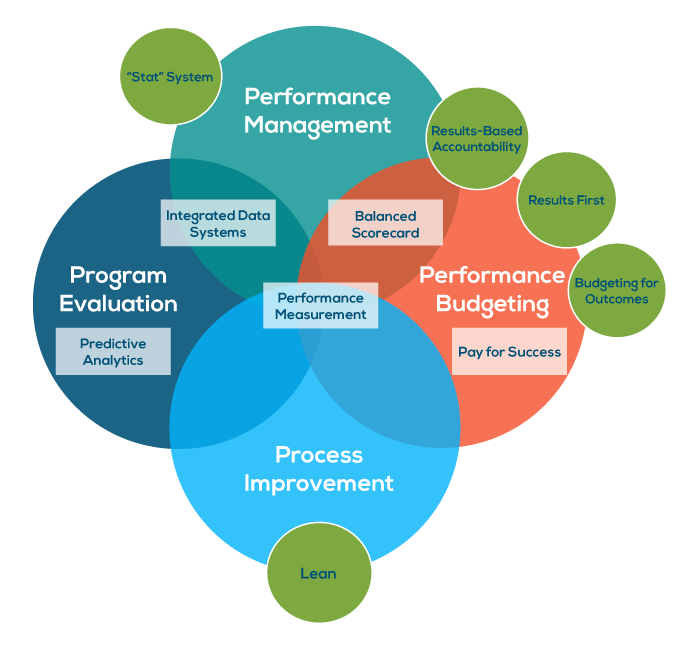
These relationships, which are discussed in more detail in the brief, are fluid and subject to interpretation, and this chart should not be construed as comprehensive or absolute. Certainly, there are additional methods and tools being used by states that are not captured here, as well as other potential connections not shown. What this chart – and the issue brief – aim to do is provide one perspective on how these various pieces are connected, in an effort to help states think through how their existing or potential initiatives to use data in decision-making can work together and reinforce one another.
Read Issue Brief